Generational Divide in Media Use and Voting Behavior
Master's thesis at LMU Munich on how generational differences in news consumption shaped party choice in the February 2025 German federal election.
Abstract
In an era of growing media fragmentation and political polarization, this thesis examines how generational differences in media consumption influence voting behavior in Germany. It draws on the Media System Dependency theory alongside a set of literature to explore the intersection of age, media usage, and voting behavior in the context of the 2025 German Federal Elections.
Utilizing the GLES Cross-Section dataset of 2025, the study employs exploratory factor analysis and conditional logit regression to assess the impact of media and demographic variables on voting behavior. The findings support the hypotheses that age and media play a crucial role in influencing voter behavior, showing how young voters and digital media users are more likely to support alternative parties, while older voters and legacy media users tend to favor traditional parties.
Furthermore, the findings suggest that the relationship between ideological positions and electoral support is mediated by the type of media an individual consumes, where there was a notable difference in behavior between digital media users and their legacy media counterparts. While the study does not aim to make rigid causal claims based on these results, it offers credible evidence for a potential causal linkage.
Overview
- Role
- Author
- Status
- Completed
- Technology
- RmclogitpsychmiceLaTeX
- Year
- 2025
- Institution
- LMU Munich — Geschwister-Scholl-Institut
- Degree
- M.A. Political Science
- Advisor
- Prof. Dr. Paul W. Thurner
- Submitted
- 21 July 2025
The Question
Germany went to the polls in February 2025 with a media system that no longer resembles the one its party system grew up in. Broadcasters and newspapers still reach very large audiences. Social platforms reach different audiences, and increasingly they reach them first — and without the editorial gatekeeping that once decided which parties were visible at all.
The thesis asks one question: to what extent do generational differences in news consumption influence party choice among German voters in federal elections? Three dimensions have to be handled at once — age, media diet and vote — and none of them behaves simply on its own.
The starting observation is a split rather than a gradient. Among 18- to 28-year-olds, social media is the single most important source of political information for almost two thirds of respondents. Among the over-62s the same figure is eight per cent, and television takes its place. These are not two ends of one distribution; they are two different information environments occupying the same electorate.
- 62.7%
- of 18–28s name social media as their most important source of political information
- 8%
- of over-62s do — for them the answer is television, at 57.4%
- 7
- parties in the choice set: CDU/CSU, SPD, Grüne, AfD, Die Linke, FDP, BSW
- ≈7,000
- respondents surveyed in the weeks after the election
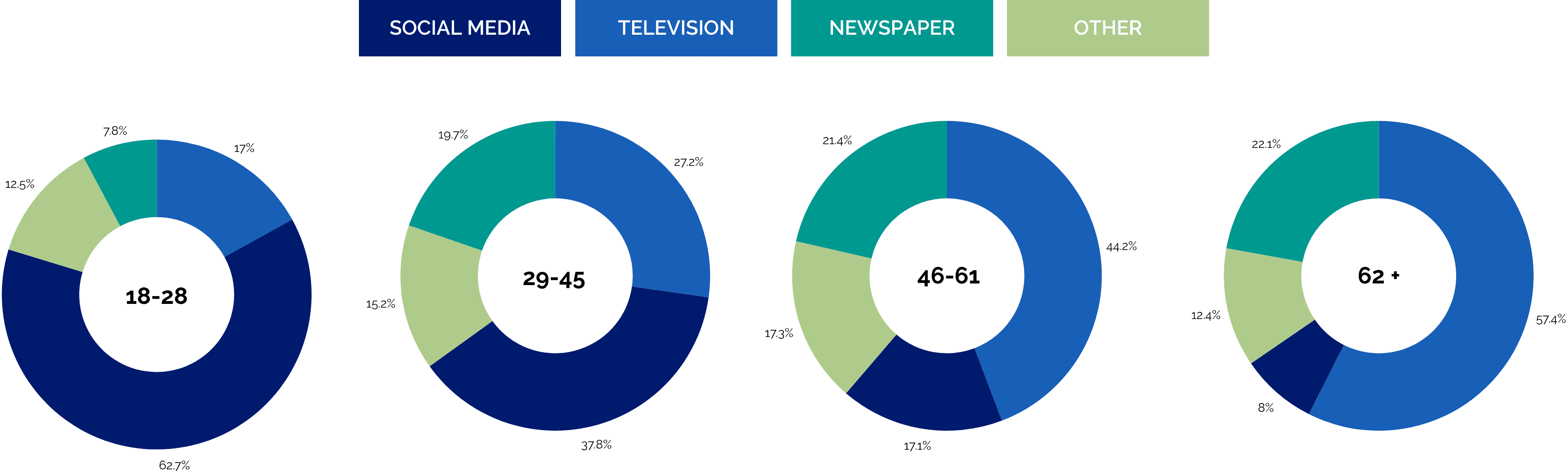
The most important source of political information, by age cohort. Social media collapses from 62.7% among the youngest voters to 8% among the oldest; television moves the opposite way, from 17% to 57.4%. Newspapers hold around a fifth of every cohort except the youngest, where they fall to 7.8%.
GLES Cross-Section Survey 2025
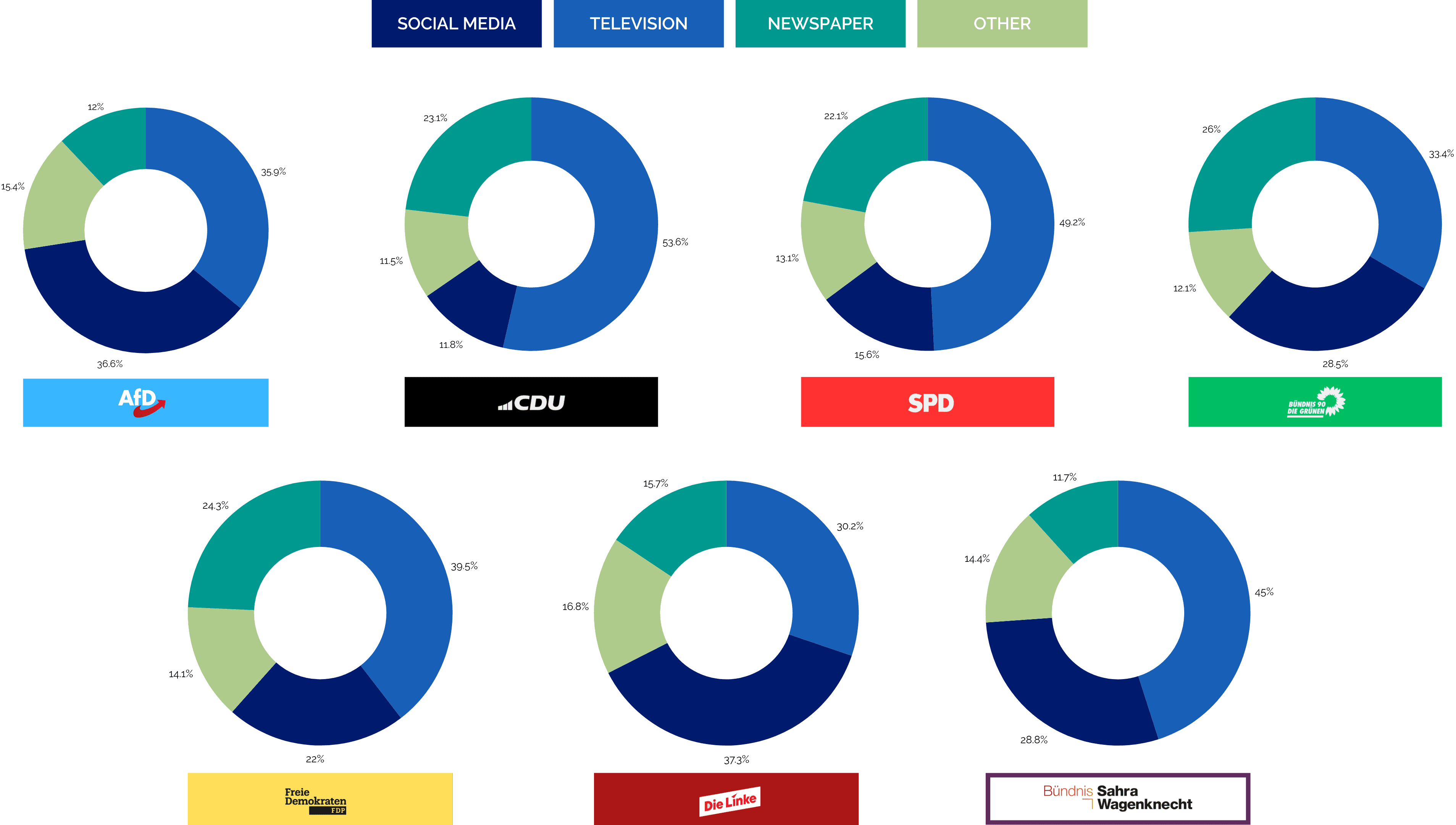
The same question, cut by the party the respondent voted for. Only two electorates put social media above television — Die Linke, at 37.3% against 30.2%, and the AfD, at 36.6% against 35.9%. They are also the two parties that gained most in February. CDU/CSU voters are the mirror image, at 11.8% against 53.6%.
GLES Cross-Section Survey 2025
Theory
The framework is built on Media System Dependency theory: the more a person relies on a particular media system to meet their informational needs, the more that system is able to shape their attitudes and behaviour. Dependency is not passive exposure. It is a relationship, and it is strongest where the medium is most relevant to the person's daily life — which is where the Digital Divide literature enters, because relevance is heavily patterned by age.
The second half of the framework is about supply rather than demand. Parties do not distribute themselves evenly across media. Legacy outlets are professionalised, institutionally gatekept, and structurally favourable to the long-established Volksparteien. Digital platforms are not gatekept in the same way, and challenger parties have used that asymmetry deliberately and effectively.
Data from the SPARTA project at the University of the Bundeswehr Munich makes the asymmetry hard to miss. On YouTube during the campaign period, the AfD accounted for 39.8% of all party posts — and 59.8% of all engagement with them. The CDU/CSU, the party that won the election, accounted for 1.5% of that engagement.
Vote choice itself is modelled through the spatial theory of voting: a voter is assumed to have an ideal position on an issue and to prefer the party closest to it, with a party's utility falling as ideological distance grows. The thesis's contribution is to ask whether that distance is discounted differently depending on where a voter gets their news.
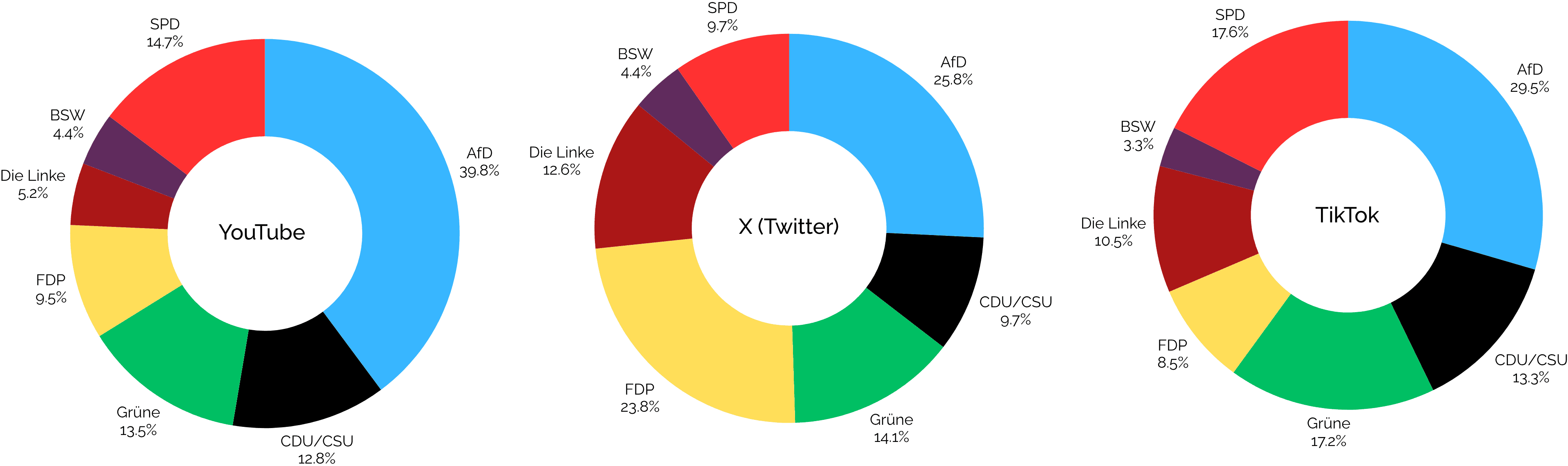
Share of campaign posts by party. The AfD leads on all three platforms; the FDP's 23.8% share on X is the one place a smaller party out-posts everybody except the AfD.
SPARTA Project, University of the Bundeswehr Munich — dtecbw.de/sparta
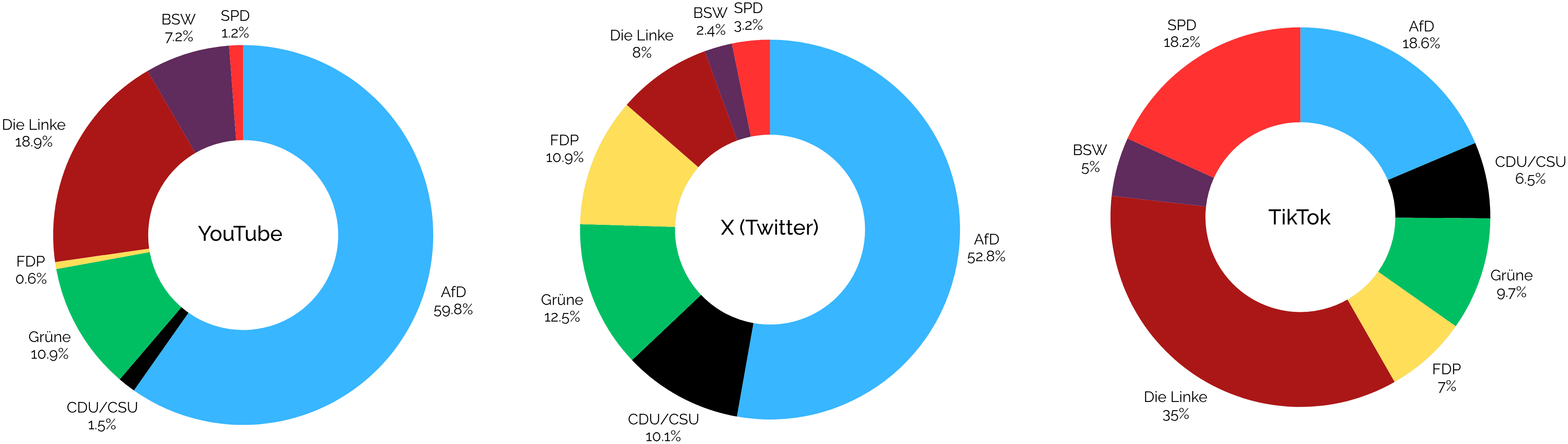
The same platforms measured by engagement rather than volume, which is where the gap widens. The two parties that dominate — the AfD and Die Linke — are precisely the two that gained most in February 2025.
SPARTA Project, University of the Bundeswehr Munich — dtecbw.de/sparta
Hypotheses
H1. Age is negatively associated with support for alternative political parties and positively associated with support for established mainstream parties. Younger voters were socialised in a digital information environment and feel less attached to the traditional parties; older voters tend to remain loyal to them.
H2. Digital media consumption increases the likelihood of supporting alternative parties, while traditional media consumption increases support for established mainstream parties. Different media environments offer different opportunities: platforms let challenger parties campaign without passing through legacy gatekeepers, and the voters on those platforms meet that content repeatedly.
H3. Increasing ideological distance between voter and party reduces electoral support, but the magnitude of that effect differs between digital and legacy media users. This is the hypothesis that puts the two halves of the framework together: not whether proximity matters, which it plainly does, but whether media diet changes how steeply support falls away from it.
The Sample
The data is the GLES Cross-Section 2025, run by GESIS as part of the German Longitudinal Election Study. Fieldwork ran from 24 February to 7 April 2025 — beginning the day after the election — using a multi-stage register sample with online and paper-and-pencil interviews of 60 to 90 minutes.
The raw file holds 7,337 observations across 570 variables. Seventy-eight of those were kept: the vote-choice variable, year of birth, gender, federal state, the ego and party-position scales behind the issue-distance measures, and roughly a dozen media-use variables covering public and private television, nine national newspapers, radio, general internet use, news websites, fourteen social platforms, political use of those platforms, and visits to party profiles.
The realised sample skews older, as German electoral samples generally do — Baby Boomers are 40.2% of respondents and Gen Z is 9.9%, partly because a large share of that cohort is still below voting age. Self-reported vote shares track the real result for the CDU/CSU almost exactly, at 29.5%, but over-represent the Greens and the SPD. That gap is expected in self-reported survey data and is noted as a limitation rather than corrected away.
- 7,337
- observations in the raw GLES file
- 570 → 78
- variables, narrowed to the subset the study needs
- 24 Feb – 7 Apr
- fieldwork window, opening the day after the election
- 40.2%
- Baby Boomers; Gen Z is 9.9% of the realised sample
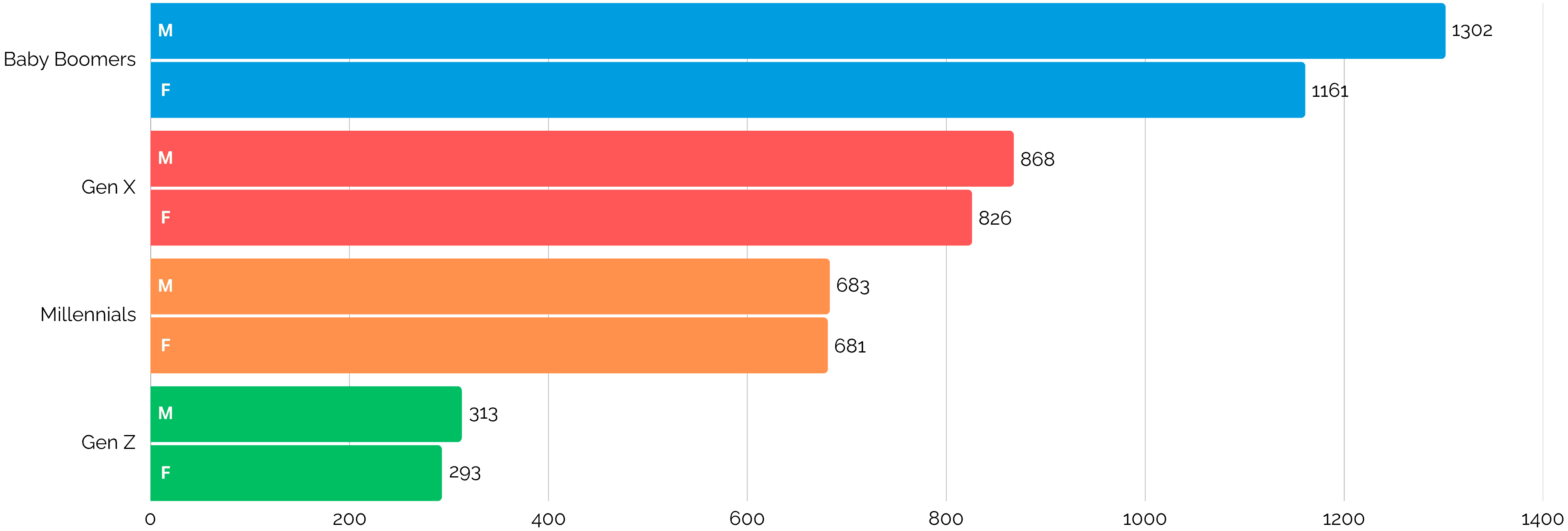
Respondents by generational cohort and gender. Gender is close to balanced within the younger cohorts and drifts apart among the Baby Boomers.
GLES Cross-Section Survey 2025
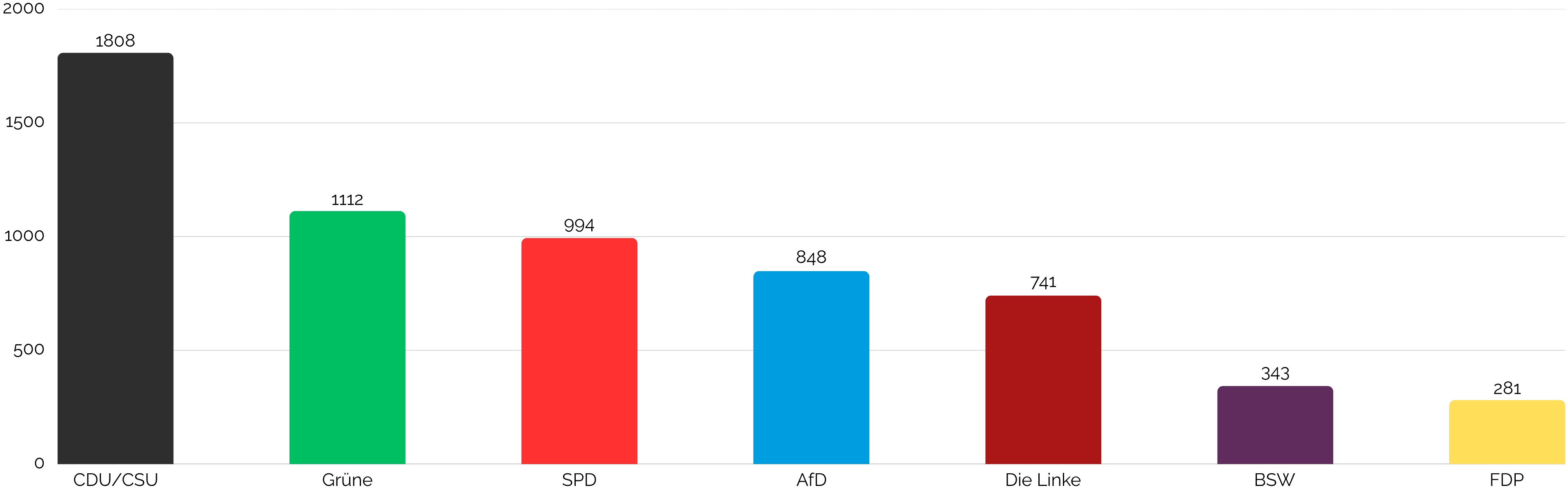
Reported second votes, as respondent counts. The CDU/CSU's 1,808 works out at 29.5%, close to the official result; the Greens at 18.1% and the SPD at 16.2% are over-represented relative to it.
GLES Cross-Section Survey 2025
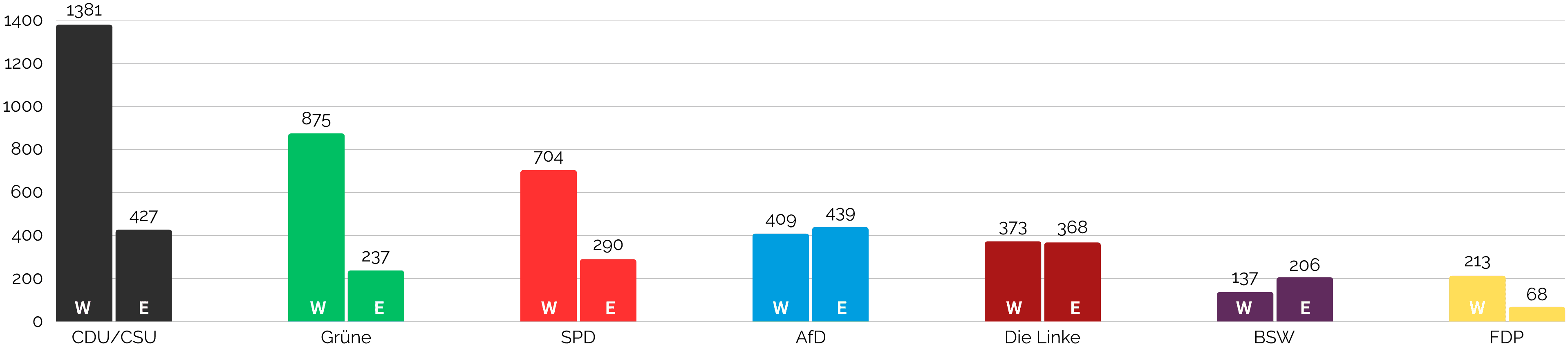
West against East. Thirty-five years after reunification this is still the sharpest single cut in the data: the AfD and the BSW draw more support from the East than the West, and Die Linke draws the same — even though the East accounts for only a third of the sample.
GLES Cross-Section Survey 2025
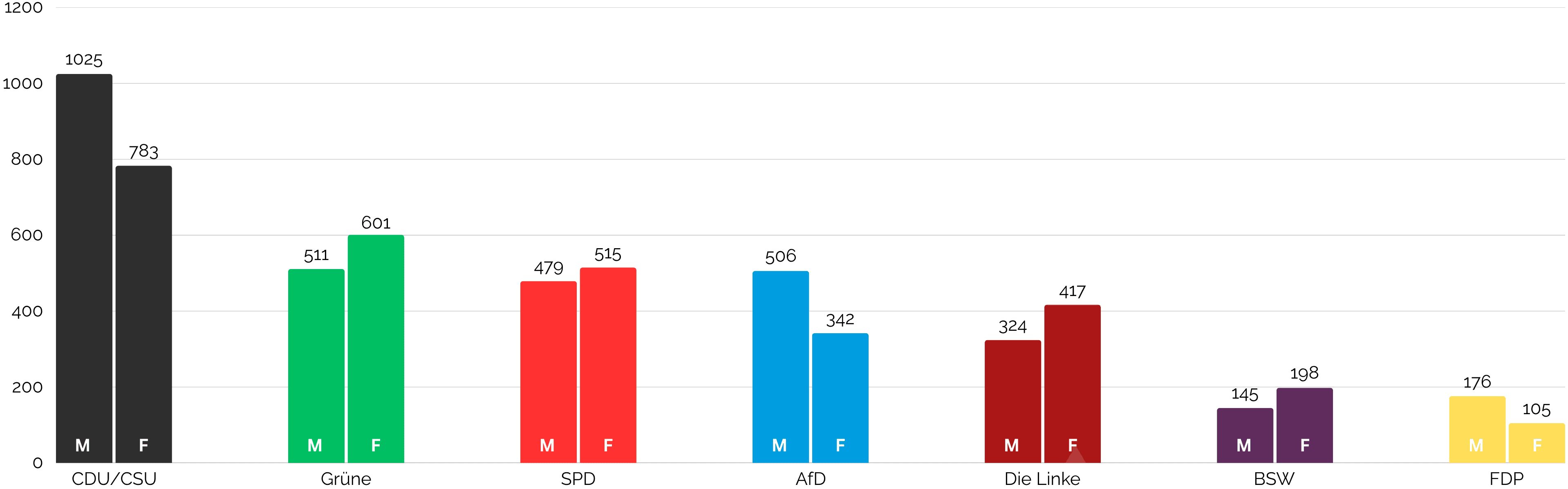
The same counts by gender. The sharpest splits are the AfD and the FDP, both male-leaning, against Die Linke and the BSW, both female-leaning — the same four parties whose gender gaps reappear in the model's predicted probabilities.
GLES Cross-Section Survey 2025
Method
Vote choice is an unordered pick from a fixed, mutually exclusive set of seven parties, so the model belongs to the discrete choice family. A plain multinomial logit would only carry attributes of the voter. Ideological distance is an attribute of the voter and the party at once, which is why the study uses a conditional logit — McFadden's choice model — with alternative-specific constants and the SPD as the reference alternative.
Ideological distance is built from four eleven-point scales: left–right, immigration, climate, and taxes against social services. Each respondent places themselves on every scale and separately places each party, and the distance is the city-block absolute difference between the two. An R loop computes all four scales against all seven parties for every respondent, and the four are averaged into one distance per voter–party pair.
The media variables posed the harder problem. Around a dozen correlated frequency and count measures is too many to enter directly, and the single 'most important source' question is too blunt — it forces respondents into mono-media categories that nobody actually inhabits. The study therefore reduces the dimensions with exploratory factor analysis rather than PCA, because factor analysis separates shared variance from error variance and yields factors that can be interpreted rather than components that are merely compressed.
Missing data was handled with multiple imputation by predictive mean matching (ten imputations), which keeps imputed values inside the range actually observed. Factors were extracted by principal axis factoring with varimax rotation, scored by the Bartlett method, and standardised before entering the model — which is why the media coefficients below are read per standard deviation rather than per unit.
Two Media Factors
The factor analysis returned two clean, stable dimensions. Television, radio and print frequency load together on one; frequency of political social media use, the number of platforms used, the number of explicitly political platforms used, visits to party profiles, and online political participation load together on the other. Every variable clears the conventional 0.4 threshold on its own factor, and both factors have eigenvalues above 1.
The factors were named legacy_media and social_media after the fact. The extraction is data-driven; only the naming is interpretive.
The most interesting result here is a negative one. General internet use and news-website use loaded weakly on both factors and would not form a third. Reading news online, it turns out, does not group with social media use — and does not group with legacy media either. Visiting a newspaper's website is closer to reading the newspaper than to scrolling a feed, and neither relationship is strong enough to be a dimension of its own.
The two-factor solution explains about 44% of total variance. That is moderate rather than excellent, and the thesis says so: with only two factors extracted from self-reported behavioural measures, a richer set of legacy-media and internet variables would likely have done better.
Rotated factor loadings
| Variable | Social media | Legacy media |
|---|---|---|
| TV frequency | — | 0.698 |
| Radio frequency | — | 0.448 |
| Print frequency | — | 0.497 |
| Social media political frequency | 0.698 | — |
| Social media platform count | 0.897 | — |
| Alternative platform count | 0.745 | — |
| Digital party visits | 0.521 | — |
| Social media participation | 0.552 | — |
| Fit | ||
| SS loadings | 2.460 | 1.027 |
| Proportion of variance | 0.308 | 0.128 |
| Cumulative variance | 0.308 | 0.436 |
Principal axis factoring with varimax rotation; loadings below 0.4 omitted. Eigenvalues fall from 2.80 to 1.44 to 0.78, so the Kaiser criterion and the scree plot agree on two factors.
Model Results
The media factors are the result the study was built to produce, and they are unambiguous. Every legacy-media term except the CDU/CSU is negative and significant: the more legacy media a respondent consumes, the less likely they are to choose any party over the SPD. Every social-media term is positive and significant, and the largest of them belongs to the AfD.
Because the factor scores are standardised, each coefficient is read per standard deviation of media consumption. One standard deviation more social media use raises the odds of choosing the AfD over the SPD by 89.5%, and Die Linke over the SPD by 76%. One standard deviation more legacy media use cuts the odds of choosing the BSW over the SPD by 49%, and the AfD by 41%.
Ideological distance behaves exactly as spatial theory predicts — every coefficient is negative and significant below any conventional threshold — with the steepest slope belonging to the AfD, at −1.205. Small disagreements with the AfD cost it support faster than small disagreements cost any other party.
Age, entered on its own, does almost nothing. That is a scale artefact rather than a finding: one unit is one year, so a coefficient of −0.016 for the Greens is a real effect measured in an implausibly small step. Age becomes legible only in the predicted probabilities, over the full spectrum. Region, by contrast, is emphatic even as a single term: living in the East raises the log-odds of choosing the BSW, Die Linke or the AfD over the SPD by more than a full point in each case.
Media use — coefficients and odds ratios
| Party (vs. SPD) | Legacy β | Legacy OR | Social β | Social OR |
|---|---|---|---|---|
| CDU/CSU | 0.003 | 1.003 | 0.173** | 1.189 |
| FDP | −0.432*** | 0.648 | 0.468*** | 1.597 |
| Grüne | −0.311*** | 0.732 | 0.358*** | 1.431 |
| Die Linke | −0.543*** | 0.581 | 0.565*** | 1.760 |
| AfD | −0.531*** | 0.588 | 0.639*** | 1.895 |
| BSW | −0.679*** | 0.507 | 0.485*** | 1.625 |
Conditional logit estimates on standardised factor scores, so each coefficient is a one-standard-deviation change. The SPD is the reference alternative. *** p < 0.001, ** p < 0.01.
Issue distance and demographics
| Term | Coefficient |
|---|---|
| Average issue distance | |
| CDU/CSU | −0.978*** |
| FDP | −0.963*** |
| Grüne | −1.009*** |
| Die Linke | −0.699*** |
| AfD | −1.205*** |
| BSW | −0.832*** |
| Age, per year | |
| Grüne | −0.016*** |
| Die Linke | −0.017*** |
| Resident in East Germany | |
| Die Linke | 1.117*** |
| AfD | 1.007*** |
| BSW | 1.241*** |
All terms are interactions with the party alternative, against the SPD as reference. Terms that did not reach significance are omitted. *** p < 0.001.
Predicted Probabilities
Coefficients say whether something matters. Predicted probabilities say how much, and for whom — which is where the age and media dimensions stop behaving additively and start interacting.
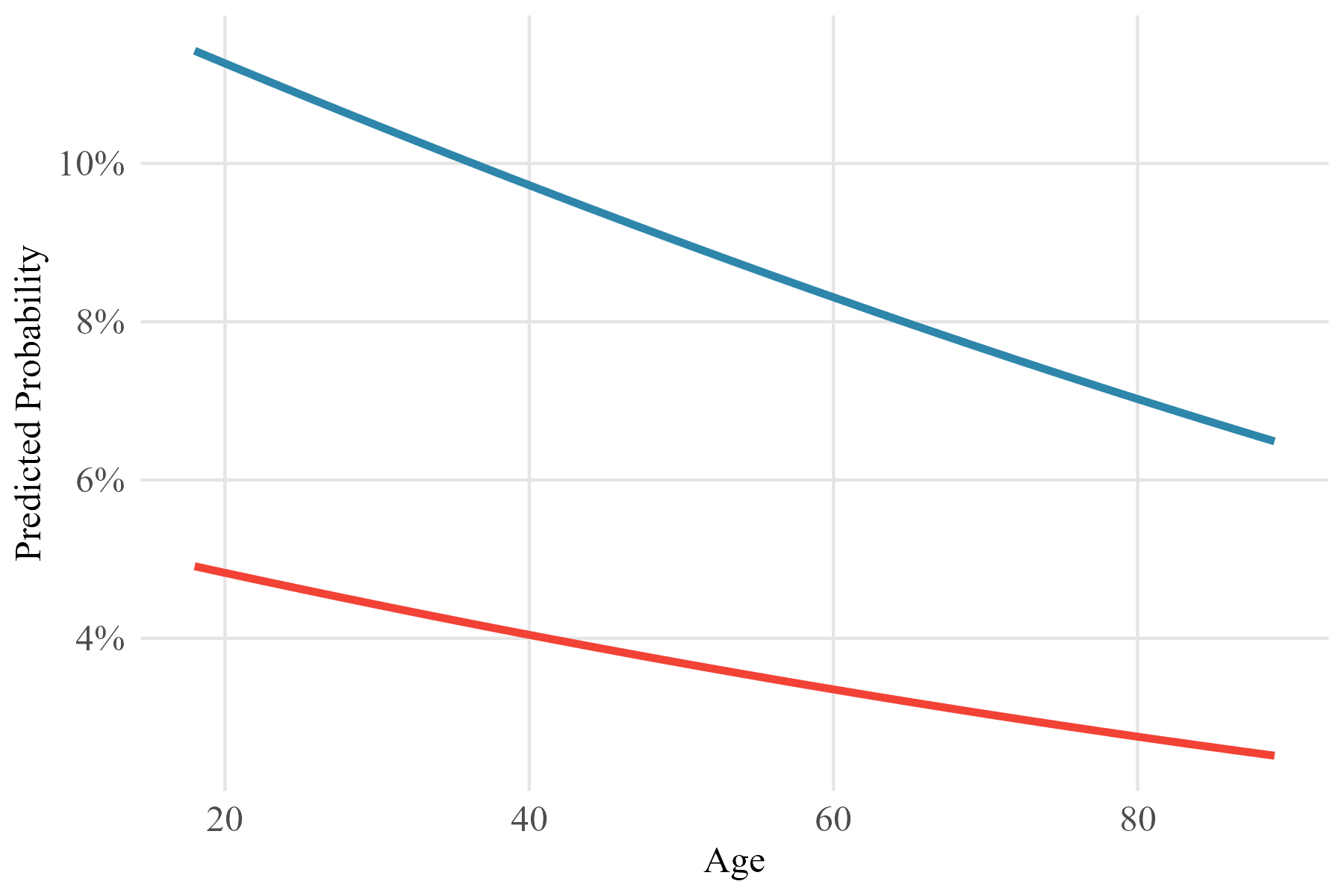
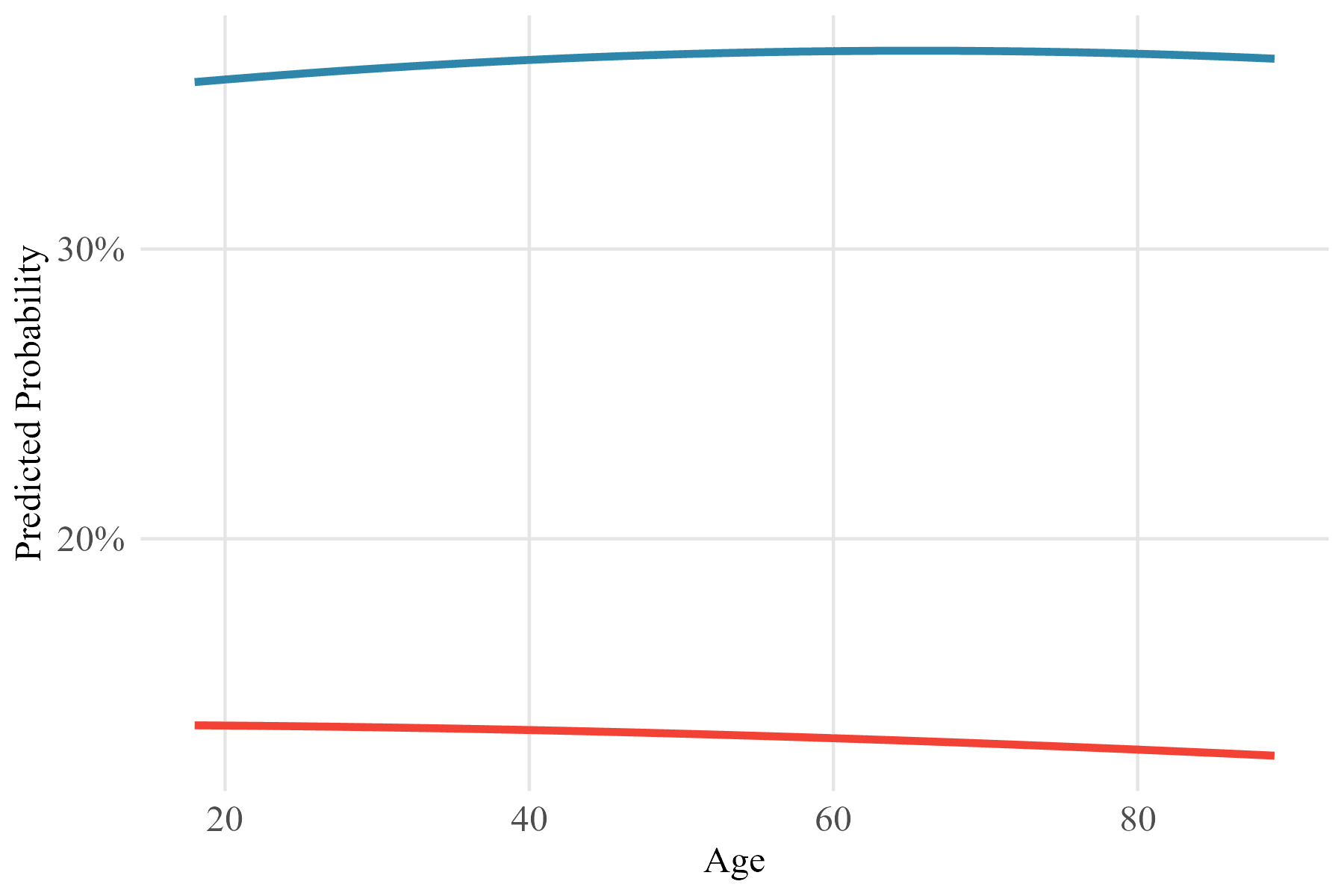
Die Linke is the clearest case of the interaction the thesis predicted: a steep decline with age among social media users, and a flat, low line for legacy media users at every age. The AfD is the surprise. Its social media line is almost flat across the whole age spectrum, sitting well above its legacy line from eighteen to ninety. Whatever the AfD did on those platforms, it did not only work on the young.
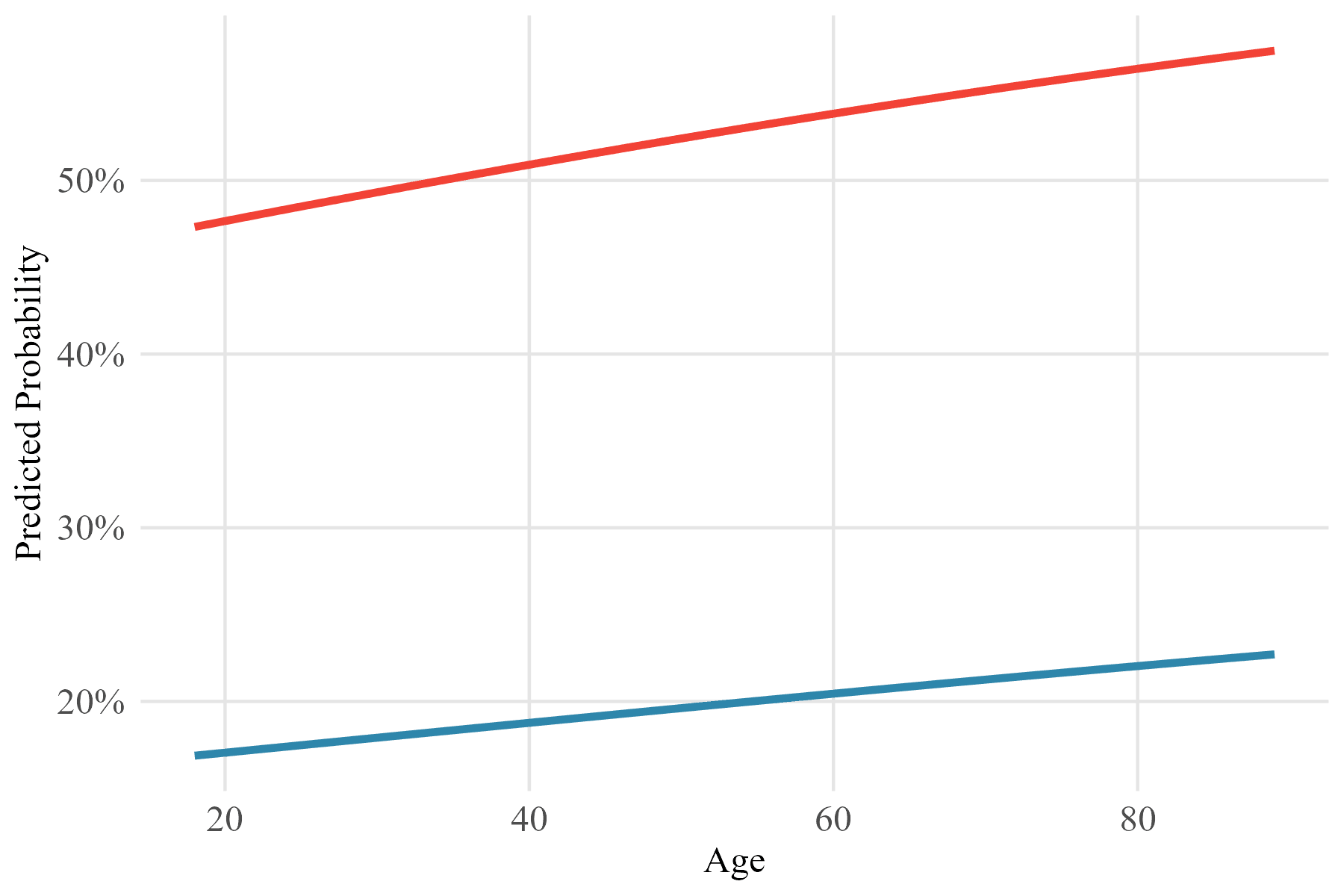
The CDU/CSU and the SPD run the other way, rising with age, with legacy media users above social media users throughout. The Greens are the exception that clarifies the rule: both media lines fall steeply with age and stay close together, which is a case where age is doing the work and media is not.
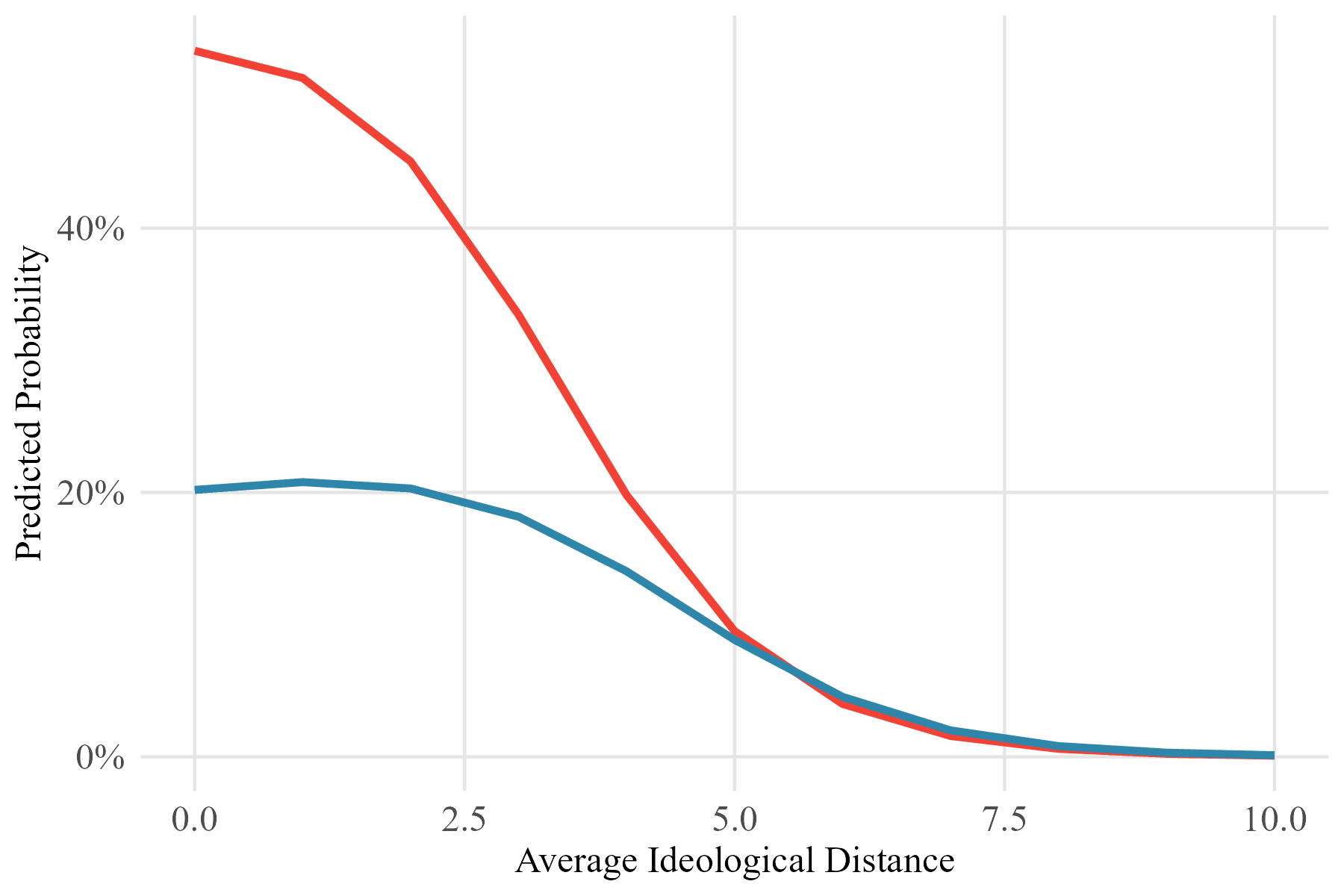
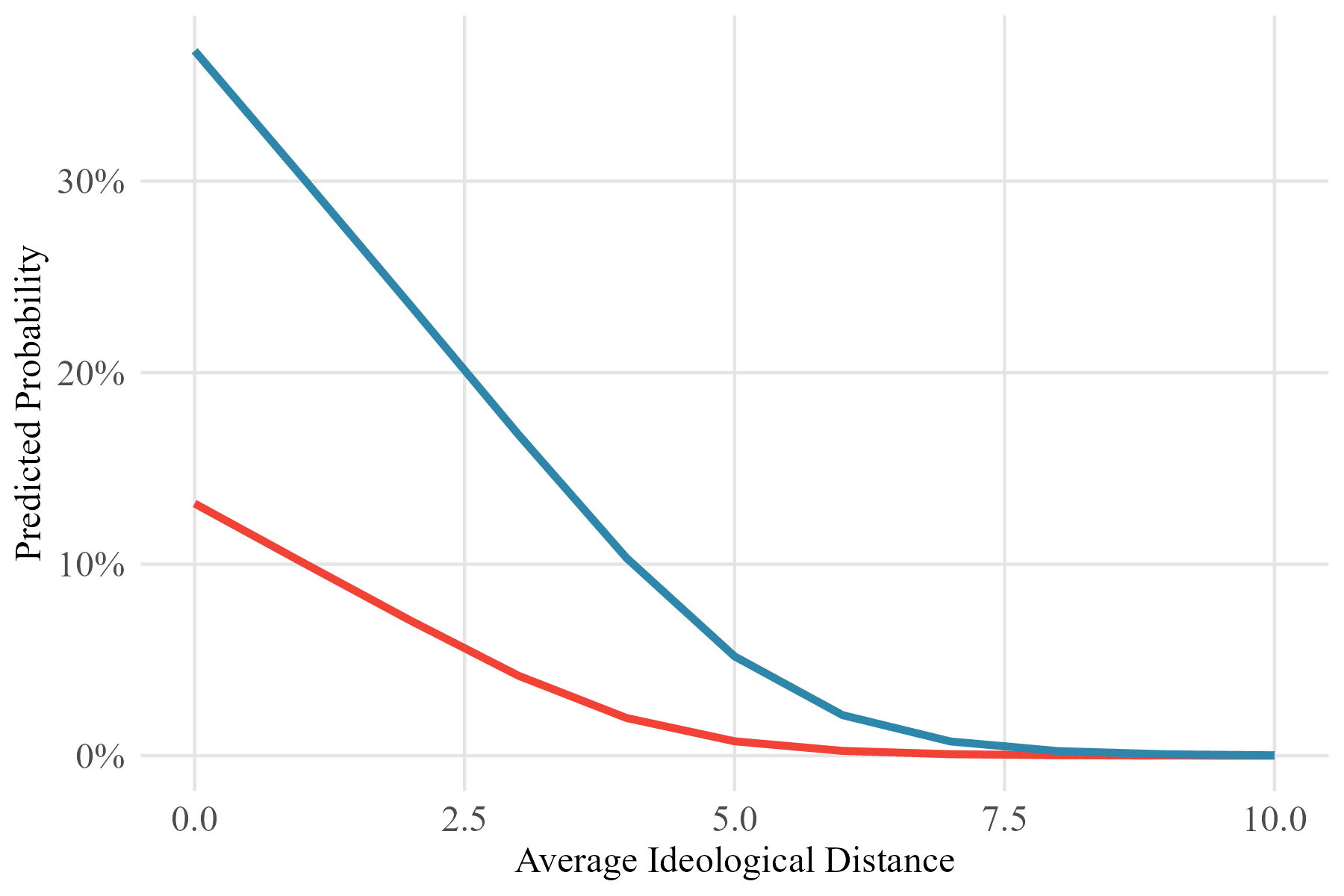
The issue-distance plots carry the third hypothesis. Both curves fall as disagreement grows, as they must. What differs is where they start. At zero ideological distance — perfect agreement — a legacy media user has roughly a 50% probability of choosing the CDU/CSU against about 20% for a social media user in the same ideological position. For the AfD the ordering reverses. Ideological proximity is not converted into a vote at the same exchange rate on both sides of the media divide.
- Legacy media
- Social media
Die Linke — the hypothesised pattern in its clearest form.
- Legacy media
- Social media
AfD — a large media gap and almost no age gradient at all.
- Legacy media
- Social media
CDU/CSU — rising with age, legacy media users above.
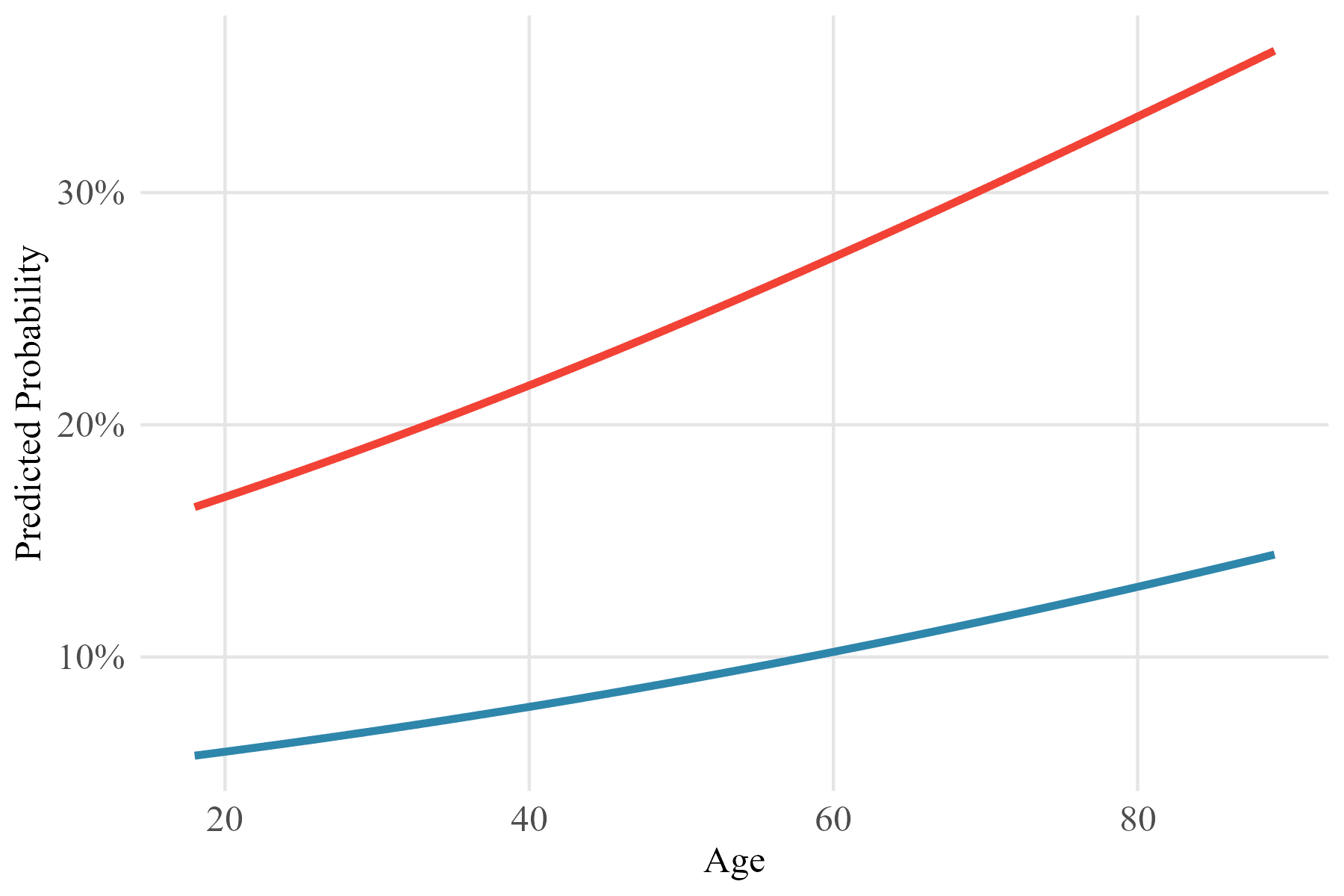
- Legacy media
- Social media
SPD — the same shape, from a lower base.
- Legacy media
- Social media
CDU/CSU against ideological distance. At perfect agreement the two media groups are more than twenty points apart; by a distance of five they are indistinguishable.
- Legacy media
- Social media
AfD against ideological distance — the same divergence with the media groups swapped, and a steeper fall.
What the Results Say
H1 is supported, with two qualifications. Die Linke and the Greens fall sharply with age and the CDU/CSU and SPD rise with it, as predicted. But the AfD is flat across the spectrum — an alternative party that did not depend on being young — and the BSW behaves like a mainstream party, drawing more support from older voters.
H2 is supported cleanly. Every social-media coefficient is positive, every legacy-media coefficient except one is negative, and the predicted probabilities separate the two groups visibly for every party in the model.
H3 is supported, including the part that was not obvious. Support falls with ideological distance everywhere, but the level at which it starts, and the rate at which it falls, depend on media diet. The same ideological position converts into a very different probability of voting depending on where the voter gets their news.
Two demographic findings sit alongside these and are worth stating in their own right. Female social media users are consistently more likely to choose Die Linke and the BSW; male social media users are markedly more likely to choose the FDP. And the East–West split is close to unconditional — East German respondents lean towards Die Linke, the AfD and the BSW largely regardless of age or media diet.
The thesis is careful about what all this licenses. A conditional logit on cross-sectional data does not establish causation, and it does not claim to. What it claims is that the direction, size and consistency of the results, together with a theoretical framework that clears the standard causal hurdles, amount to credible evidence for a causal relationship that longitudinal work could test properly.
- +89.5%
- odds of choosing the AfD over the SPD, per standard deviation of social media use
- −49%
- odds of choosing the BSW over the SPD, per standard deviation of legacy media use
- −1.205
- the AfD's issue-distance coefficient — the steepest penalty for disagreement in the model
- 1.241
- East German residence, BSW against SPD — the largest demographic effect in the model
Limitations
The design is cross-sectional. It can show that media diet and vote choice move together, and it can make the causal direction plausible on theoretical grounds, but it cannot observe an individual's media habits changing and their vote changing after it. Panel data is the obvious next step.
Media exposure is self-reported throughout. A respondent's recollection of how many days a week they watch the news is not a measurement of how many days a week they watched the news, and the factor scores inherit that limitation.
The two-factor solution explains 44% of variance, which is workable but not strong, and the internet-use variables that would not form a third factor are a gap in the instrument as much as a finding about the world. A richer set of legacy and online media measures would be the first thing to improve.
Finally, the realised sample over-reports Green and SPD support relative to the official result. This is ordinary in self-reported vote data, and the model's estimates are relative comparisons against the SPD rather than population-level vote shares, but it is a reason to read descriptive percentages here as a description of the sample and not of the electorate.